Language


Views: 269 Author: Shirley Publish Time: 2026-11-05 Origin: Site


Content Menu
● Unscented Laundry Pods vs. Regular Detergent: What Are We Comparing?
● Why "Unscented" Does Not Always Mean Fragrance-Free
>> Unscented Can Include Odor-Masking Ingredients
>> Fragrance-Free Is the More Useful Starting Point
● What Makes Laundry Detergent Suitable for Sensitive Skin?
>> Enzymes Are Not Automatically Disqualifying
● Do Unscented Laundry Pods Clean as Well as Regular Detergent?
● A Practical Framework: Formula, Dose, and Wash Conditions
>> 1. Is the Formula Appropriate?
>> 2. Does the Dose Fit the Load?
>> 3. Does the Washing Process Work?
● How to Change Detergent Without Confusing the Results
● Industry Insight: What Sensitive-Skin Claims Actually Prove
>> Quality Systems Are Not Clinical Evidence
>> Finished-Product Evidence Matters
● Our Approach to OEM and ODM Laundry Capsules
● Which Detergent Should You Choose?
>> Are unscented laundry pods better for eczema?
>> Can fragrance-free detergent still irritate skin?
>> Is liquid detergent gentler than laundry pods?
>> Do sensitive-skin detergents need to be enzyme-free?
>> Should I use fabric softener with sensitive-skin detergent?
>> Are fragrance-free laundry capsules safe for babies?
Unscented laundry pods can be a better choice for sensitive skin than fragranced regular detergent—but only when the pods are genuinely fragrance-free. A fragrance-free liquid detergent may be equally suitable and offers more dosing flexibility. The deciding factors are the formula, your individual sensitivities, and how effectively the detergent rinses from clothing—not simply whether it comes in a capsule or bottle.
At Zhongshan Xiaowang Daily Chemical Technology Co., Ltd., we approach this comparison from a formulation and manufacturing perspective. Convenience matters, but a sensitive-skin detergent must also deliver effective cleaning, consistent quality, and clear usage instructions.
This guide explains what to compare, which claims deserve closer inspection, and how consumers and private-label buyers can make better-informed decisions.

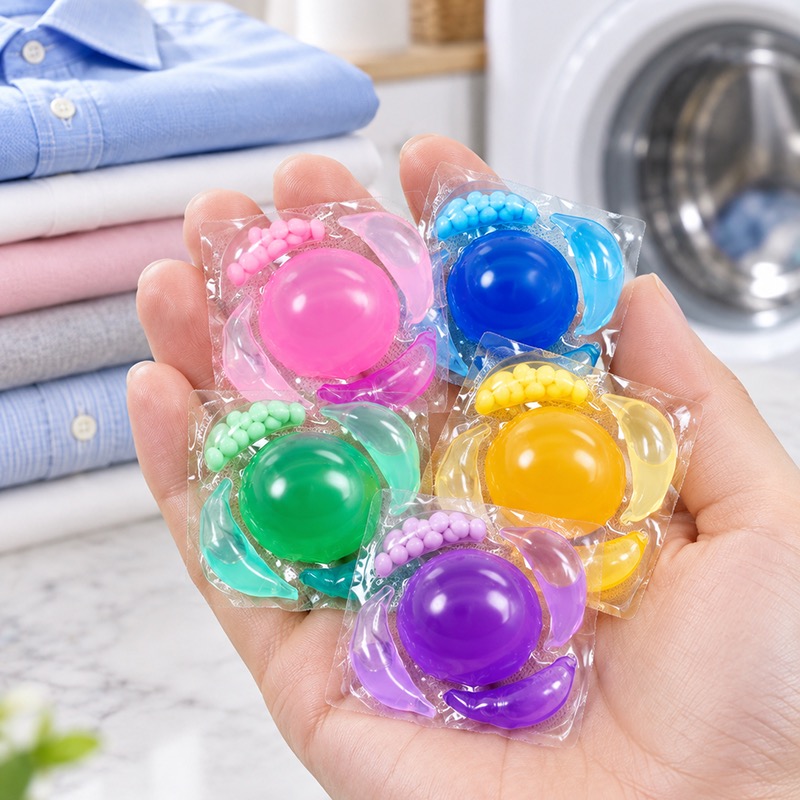
Laundry pods, also called laundry capsules, contain a premeasured detergent dose inside a water-soluble film. "Regular detergent" is a broader category that includes bottled liquids and powders, with or without fragrance.
For this comparison, regular detergent primarily means conventional fragranced liquid or powder detergent. However, fragrance-free versions are important alternatives.
The distinction matters: comparing fragrance-free pods with scented liquid detergent changes both the formula and the delivery format. Any improvement cannot automatically be credited to the pod itself.
| Comparison point | Unscented laundry pods | Regular liquid or powder detergent |
|---|---|---|
| Fragrance | May be fragrance-free; verify the formulation | Available in fragranced and fragrance-free versions |
| Dosing | Fixed dose per capsule | Adjustable within label instructions |
| Sensitive-skin suitability | Depends on ingredients and individual tolerance | Depends on ingredients and individual tolerance |
| Cleaning performance | Formula- and wash-condition dependent | Formula- and wash-condition dependent |
| Small loads | Fixed dose may offer less flexibility | Easier to measure a smaller recommended dose |
| Convenience | Premeasured, with little measuring mess | Requires measuring |
| Safety | Concentrated capsules require secure storage | All detergents require safe handling and storage |
| Value | Compare cost per correctly washed load | Compare cost per correctly washed load |
Neither format wins every category. A well-chosen formula used correctly matters more than packaging convenience.
"Unscented" generally describes a product without a noticeable perfume smell. It does not necessarily establish that fragrance materials are absent.
Some unscented products may contain ingredients that mask the odor of other components. Consequently, choosing detergent by smell alone is unreliable.
A product marketed as unscented can also genuinely contain no fragrance. The practical lesson is to check the ingredient information rather than assume either outcome from the front label.
For people trying to avoid fragrance, look for an explicit fragrance-free statement supported by ingredient disclosure.
Fragrance-free products may still have a mild raw-material odor. That does not automatically mean perfume has been added.
Dermatology guidance commonly recommends fragrance-free, dye-free laundry detergent for eczema-prone skin. However, removing fragrance does not guarantee that every other ingredient will suit every user.
Fragrance is a relevant consideration for people with fragrance sensitivity and eczema. Dyes add product color rather than cleaning power, so fragrance-free, dye-free formulas provide a sensible starting point.
That does not mean every scented detergent causes irritation or every dye-free product prevents it. Individual triggers differ.
From a product-development perspective, our priority would be to justify each ingredient's function rather than add decorative features that complicate a sensitive-skin positioning.
Surfactants provide cleaning action. Other ingredients support stain removal, stability, water management, and product preservation.
A short ingredient list is not automatically gentler, and a long one is not automatically problematic. Concentration, formulation, use conditions, and individual allergies all matter.
Similarly, "natural" does not establish skin compatibility. Essential oils are fragrance materials, even when their origin is botanical.
An enzyme-free formula is not a universal requirement for sensitive skin.
Laundry products listed by the National Eczema Association include enzyme-containing formulations. This demonstrates why ingredient categories should not be judged in isolation.
If you have an identified allergy, follow individualized clinical advice. Otherwise, assess the finished product and available evidence rather than assuming that enzymes necessarily make detergent unsuitable.
A suitable detergent still needs correct use. Follow its instructions for load size, soil level, water conditions, and machine type.
Pods simplify measuring but cannot be divided to create a smaller dose. Liquid detergent allows finer adjustment within the recommended dosing range.
If residue or incomplete dissolution occurs, investigate loading, cycle selection, and product instructions before assuming that switching formats alone will solve the problem.
They can, but fragrance-free status is not a performance test.
Perfume changes the scent experience; it does not establish whether stains have been removed. Likewise, low odor after washing does not prove that a detergent cleaned poorly.
For a meaningful comparison, evaluate:
- Everyday soil and body-oil removal.
- Performance on relevant stains.
- Results at the intended wash temperature.
- Compatibility with the washing machine.
- Visible residue and capsule dissolution.
- The need for repeat washing.
As manufacturers, we would compare candidate formulas under equivalent conditions: the same fabrics, stains, loads, water conditions, and cycles.
Without those controls, claims that pods are "stronger" or regular detergent is "more thorough" are difficult to interpret.
A useful way to evaluate laundry products is to separate three questions.
Check fragrance status, dyes, disclosed ingredients, and any known personal triggers.
For private-label buyers, confirm that the tested formula matches the formulation being supplied. A report for a different version cannot establish the same result for your product.
A fixed-dose pod can simplify a predictable laundry routine. An adjustable liquid may suit households that frequently wash small loads.
Neither is inherently better. The goal is an appropriate dose—not the smallest possible quantity or the strongest possible concentration.
Evaluate the detergent in the conditions customers actually use.
A useful manufacturer's test plan should include intended temperatures, representative loads, relevant machines, and realistic storage conditions. Performance verified under one favorable laboratory condition should not be generalized to every household.
This framework helps separate a formulation issue from a dosing or washing-process issue.
Changing several products at once makes it difficult to identify what helped.
Use this practical routine:
1. Choose one fragrance-free, dye-free detergent with accessible ingredient information.
2. Follow its dosing instructions and your machine's guidance.
3. Avoid introducing a new softener, scent booster, or dryer sheet simultaneously.
4. Keep the load type and washing routine reasonably consistent.
5. Check for visible detergent residue or incomplete pod dissolution.
6. Record the product, dose, cycle, and any symptoms you notice.
An extra rinse may be helpful for some sensitive-skin users, although it uses additional water and is not a substitute for correct dosing.
Do not apply concentrated detergent directly to your skin as a home "patch test." Laundry detergent is not a leave-on skincare product.
Persistent or recurring rashes deserve medical assessment. A dermatologist can help distinguish possible contact allergy from other causes; laundry changes alone cannot diagnose the problem.
ISO 9001 concerns an organization's quality management system. It supports a structured approach to consistency and improvement, but it does not prove that a particular detergent cannot irritate skin.
Similarly, an MSDS or SDS communicates relevant hazard and handling information. It is not a clinical certificate of suitability for eczema.
A REACH-related test report must be read within its actual scope: the sample tested, substances assessed, methods, limits, and date. It should not be presented as blanket proof of dermatological safety.
For a sensitive-skin laundry capsule project, buyers should request:
- A clear formulation specification and ingredient information.
- Written confirmation of fragrance and dye status.
- Relevant finished-product testing and its limitations.
- Stability and dissolution testing.
- Batch specifications and traceability.
- Packaging instructions and safety warnings.
- Evidence supporting any proposed skin-related claim.
Phrases such as "hypoallergenic" or "dermatologically tested" need context. Ask what was tested, how it was tested, and what the result actually supports.
A credible product brief distinguishes reduced exposure to selected ingredients from a guarantee that nobody will react.
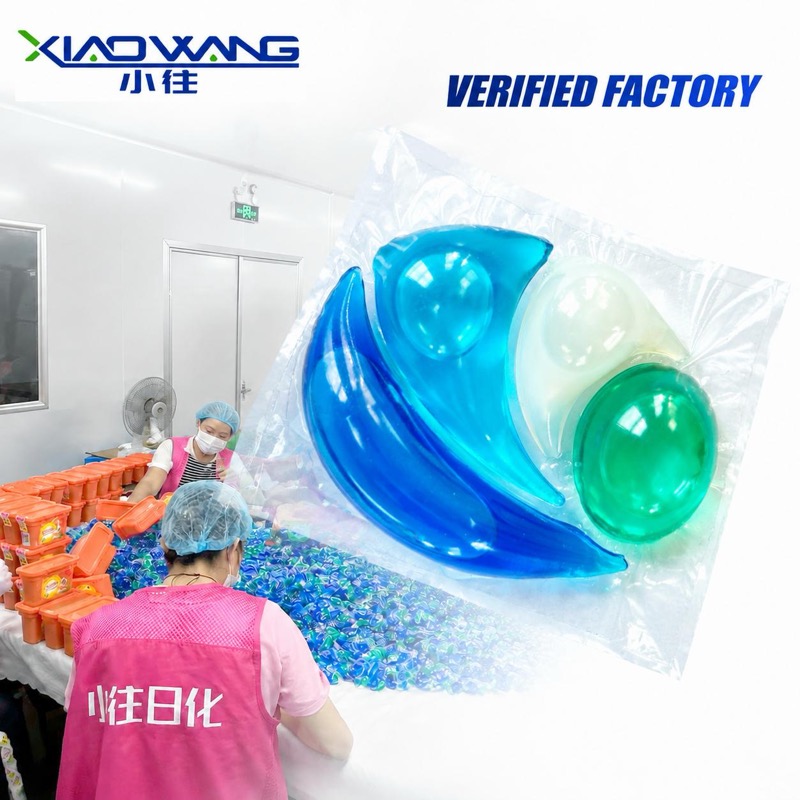
Zhongshan Xiaowang Daily Chemical Technology Co., Ltd. develops and manufactures laundry capsules for global OEM and ODM customers, including formulation customization and packaging solutions.
Our company background includes:
- A 10,000-square-meter factory.
- Six production lines.
- Monthly production capacity of 500 tonnes.
- An internal research and development team with experts bringing ten years of industry experience.
- Long-term relationships with DuPont, Milliken, Dow, Givaudan, and BASF.
- ISO 9001 certification, Eurofins-tested REACH compliance reports, and MSDS documentation.
These company details describe manufacturing capabilities and available documentation. They should not be interpreted as evidence that every formula is clinically proven suitable for sensitive skin.
For a fragrance-free project, we recommend starting with the intended market, target customer, ingredient restrictions, dose, performance expectations, and packaging requirements. Claims and testing should then be matched to the actual finished product.
Choose genuinely fragrance-free laundry pods if you value premeasured convenience and their labeled dose suits your normal loads.
Choose fragrance-free liquid detergent if you need more flexibility for varying load sizes.
Conventional fragranced detergent may suit people without relevant sensitivities, but it is not the preferred starting point when fragrance avoidance is the goal.
For households using pods, handle them with dry hands, never puncture them, and keep them sealed in their original packaging, locked away from children. Fragrance-free does not mean harmless in concentrated form.
For brands developing a sensitive-skin laundry range, contact Zhongshan Xiaowang Daily Chemical Technology Co., Ltd. with your target market, desired dose, ingredient requirements, packaging format, and testing expectations. Request a formulation consultation, sample evaluation plan, and documentation review before finalizing product claims.
They may be preferable to fragranced detergent when genuinely fragrance-free and dye-free. However, fragrance-free liquids can also be suitable. Individual tolerance and clinical advice remain important.
Yes. Fragrance is only one possible trigger. Other ingredients, individual allergies, and the washing routine may affect suitability.
Not inherently. Liquid offers adjustable dosing, while pods offer a fixed dose. Compare the formulations and intended use rather than assuming one format is gentler.
Not universally. Some products listed by the National Eczema Association contain enzymes. A known allergy requires individualized advice, not a blanket rule for everyone.
Consider avoiding fragranced softeners and dryer sheets when simplifying your routine. Adding fragrance through another product can undermine fragrance avoidance.
Fragrance-free, dye-free detergent is a reasonable starting point for washing baby clothes, but no formula guarantees tolerance. Capsules must never be accessible to children.
1. American Academy of Dermatology. "How can I find eczema friendly products?" Guidance on fragrance-free versus unscented products and fragrance-free, dye-free laundry detergent. [Read the guidance]. [aad]
2. U.S. Environmental Protection Agency. "Safer Choice Fact Sheet—Fragrance-Free." Definitions of fragrance-free and unscented, including masking scents. [Read the fact sheet]. [epa]
3. National Eczema Association. "Seventh Generation Laundry Detergent Packs." Example of a listed fragrance-free, dye-free, enzyme-containing detergent; includes individual-sensitivity limitations. [View the product information]. [nationaleczema]
4. American Academy of Dermatology. "Chronic spontaneous urticaria: Effective treatment possible." Laundry guidance covering fragrance-free detergent, extra rinsing, and avoiding softeners and dryer sheets. [Read the guidance]. [aad]
5. U.S. Consumer Product Safety Commission. "CPSC and ACCC Warn of Poison Dangers with Liquid Laundry Packets." Guidance on handling, storage, and concentrated-detergent hazards. [Read the safety guidance]. [cpsc]
6. International Organization for Standardization. "ISO 9001 explained." Scope and purpose of quality management system certification. [Read the explanation]. [iso]